
Jesus’ Final Warning: The Rich Bring Hell upon the World
23rd Sunday after Pentecost – Lk 20:45-21:36
I am tardy for this last in my series of blogs on Luke and HARP during this lectionary Year C. I was scrambling to shape this material for a Center & Library for the Bible and Social Justice webinar last night with Chuck Collins (right), a stimulating conversation that we’ll make available when they send the recording.
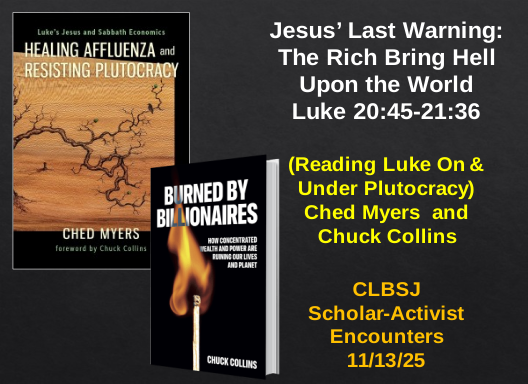
A year ago, I asked Chuck to write the foreword to HARP because I considered his amazing work at inequality.org—mapping socio-economic disparity and calling for system transformation—to be the best complement to my study of Luke’s Jesus and Sabbath Economics. Chuck (an activist Catholic) is truly carrying on Jesus’ uncompromising critique of the rich while embracing God’s dream of equity and justice, most recently in his just-released Burned by Billionaires.
We highly recommend that you buy and read both books, together, in your study circle, classroom, or church adult ed group. In that spirit, we offered a “bundle” deal of both books (signed!) for $50 (our cost) to participants of our recently-completed Zoom study series “Reading Luke On and Under Plutocracy.” Well, we have a few bundles left in our office, so we’ll offer the same deal to the first five of you who email Chris (inquiries@bcm-net.org; U.S. only)!
Thanks to those of you who have regularly taken time to follow the blog year. (My apologies to those of you lamented that I haven’t posted early enough in the week to be useful for Sunday sermon prep; I’ve been peddling as fast as I can!) I’ll now go back to blogging twice a month on a wide variety of topics and BCM 2026 programs, and hope you’ll keep tuning in.
In this last Luke blog I focus on a text that I do not explore in HARP—a bonus for those of you who have hung in there with me this year! It is the culminating articulation of Luke’s argument, concerning Jesus’ argument, concerning Plutocracy as the primary pathology of our civilization. This argument goes back to the roots of the ancient prophetic tradition, yet remains all too relevant right now. And because context matters, this pathology can be summed up in contrasting images named in a report from this week’s NY Times (below). Such archetypal contrasts between rich and poor represent a key trope in Luke’s gospel, recurring repeatedly in the narrative arc of Luke’s storytelling, as we have seen, and speaks to the text of this week’s blog.

As I’ve pointed out multiple times, the middle part of the Third Gospel—the “Special Section” of chapters 12-19, which is mostly uniquely Lukan material—is structured on a scaffolding of six episodes that portray rich men, the first five of which are decidedly unflattering (below).

In other words: Repetition is the key to pedagogy! These vignettes all lead up to the story of Zaccheaus, which culminates the series with the healing of this rich man through the practice of redistribution and reparation. This series, which I explore in Part III of HARP, maps the real society in which Jesus lived and Luke wrote, and articulates the core story within the larger narrative of Luke, in which Jesus’ diagnoses the pathologies of Affluenza and Plutocracy.
But you’ll notice here that there is a seventh rich man episode—an appropriate Sabbath Economics number!—that depicts wealthy lawyers and a poor widow, set in front of the Temple treasury in Luke 21. Like the Lazarus and Dives and the poor blind man/Zaccheaus stories, it narrates a rich/poor dyad (below; note the similar vocabulary across these three dyads).

I decided in the book to conclude the “rich man series” with the Zaccheaus story in order to end on a hopeful note. While Luke’s relentless string of caricatures portray the bad news about the killing system of the wealthy, ultimately his gospel is also about good news to the poor and the healing even of the rich—if they (we) walk the Recovery Way of reparation. But if the Zacchaeus story is comic (in the sense of a happy outcome), the Temple treasury scenario is tragic, portraying how a widow is impoverished by tithing demands of the Temple system. This last vignette represents “the last straw” for Jesus’ critique of his people’s culture and politics of inequality, and leads to his indictment and repudiation of the entire Judean economic system, on which Jesus summarily pronounces doom (21:5–6).
This triptych concludes Luke’s Jerusalem narrative (19:28-21:38), followed by Luke’s version of the “Synoptic Apocalypse” (21:8-36). (This sequence overlaps with the lection for the 23rd Sunday after Pentecost, 21:5-19). Based upon Mark 12:38–13:2, the triptych depicts Jesus in an escalating, triple confrontation with:
- lawyers who predate on widow’s estates,” covering their crimes with public piety;
- the Temple treasury, which supports its rich (plousios) patrons but impoverishes a poor (penichros) widow;
- and the Temple system itself (21:5-6).
Note (right) the echos to another triptych that opens the Jerusalem section of Luke’s story, consisting of Jesus’ march into the city; his lament over the city ( embodying the vocation of a “weeping prophets” of the haftorah); and his direct action in the Temple regarding unjust economics.

Jesus focuses first on the way lawyers enrich themselves by exploiting the estates of vulnerable widows—a practice that has not disappeared in our time. He then points the camera toward the treasury, contrasting gifts of wealthy patrons who benefit from this economic system, and a widow who must part with her last pennies to fulfill her tithing obligation. In both episodes, the widow represent the most vulnerable group in that society, disenfranchised by both gender and status. Of course, the “widow’s mite” story has long been defanged and domesticated by our churches, and turned into a romantic notion of how “even the poor tithe.” But this is not a commendation by Jesus, but a condemnation of how disparity dehumanizes the least. Then, in response to his companions’ cowering admiration for the edifices of the Second Temple (21:5), Jesus draws a direct connection between oppression and the eventual destruction of Judea’s social-political-economic system (21:6). To talk about that, he launches into his longest monologue—the so-called Synoptic Apocalypse—many parts of which still overshadow our world today!
Jesus commences—in the gospel reading for this Sunday—with a sober warning: “Watch out!” (Gk blepete). It specifically counsels resistance to demands for loyalty made by powerful leaders (21:8), particularly their “patriotic deceptions” concerning their wars (21:9). They insist these will solve the nation’s problems, an ancient ruse resurrected most recently by Trump to justify attacks on domestic immigrants and Venezuelan fishermen, and by Netanyahu to slaughter Palestinians. Jesus counters that war cannot end conflict or bring justice—it just fuels the same old sorrows of empire (21:10), including large scale environmental disruption (21:11)! Such resistence, Jesus adds in a reality check, will inevitably bring suppression and criminalization (21:12-19). This reminder of the cost of discipleship under empire could not be further from modern, Trump-lauding Rapturists who huckster a “beam me up Scotty” escape from all consequence for “believers,” even as they support the very wars Jesus repudiates.

It is worth revisiting the Jerusalem entry triptych to see how, after Jesus’ very political nonviolent march on Jerusalem, he turns to a prophetic lament over the city 19:41. It is a poignant moment of realization that his own people are doomed to be crushed by the very political forces he has resisted throughout his ministry, just as he himself will be crushed. Because this uniquely Lukan text was written in the aftermath of the actual Roman siege of Jerusalem in 70 C.E., it is replete with the bitter memory of ramparts, death and destruction of buildings—not unlike what we have witnessed in Gaza these last two years.

The next section of Jesus’ apocalyptic oracle reiterates the agonizing siege and ruin spoken of at the Mt. of Olives: the consequences of bad collective economic and political behavior. Jerusalem did fall to the Romans after a short-lived nationalist insurrection in the year 70 C.E., which Jesus of Nazareth, with his keen political instincts, could well have foreseen forty years earlier. The historian Josephus (a contemporary of Luke’s) wrote in aganizing detail about these events, including famine, whole families disappearing, and “the lanes of the city full of the dead bodies of the aged…” A million people who had taken refuge in Jerusalem were killed and another 97,000 taken captive, and the city razed.

It is a history all too familiar in our world. And it is why I titled this last scripture study, “Jesus’ Last Warning: The Rich Bring Hell Upon the World”–their plutocratic policies, presumptions and predations destroying worlds. This last sequence in Luke’s rich man series pulls no punches, which is why we need to muster the courage, conviction and compassion to heal Affluenza and Resist Plutocracy in our time.
Note: In this blog during Year C I’ve tried to popularize and summarize my more detailed study of texts in HARP. We hope you will engage this book, and find in it a resource for do the important work of reading our scriptures in our time of so many crises. We also need your partnership in getting word about it into “seminaries, sanctuaries and streets.” Given how the publishing industry is now, it is up to authors and their readers to spread the word about volumes that matter. Together we can build capacity to heal Affluenza and resist Plutocracy. Thanks, Ched
Another book special offer: Wipf and Stock is offering a 50% discount on books through November 30! This includes our publications

Healing Haunted Histories, Watershed Discipleship andLiberating Biblical Studies: Scholarship, Art & Action! Use code CONFSHIP at checkout. If you select Media Mail, shipping is free. It’s a perfect time for you to get a copy or buy one for a friend. Share this sale on your social channels or email lists to help spread the word!
And remember the upcoming online class on Healing Haunted Histories, facilitated by our BCM colleague Steve Taylor and Dr. Lynne Caldwell. Register before Dec 15th (right)!


